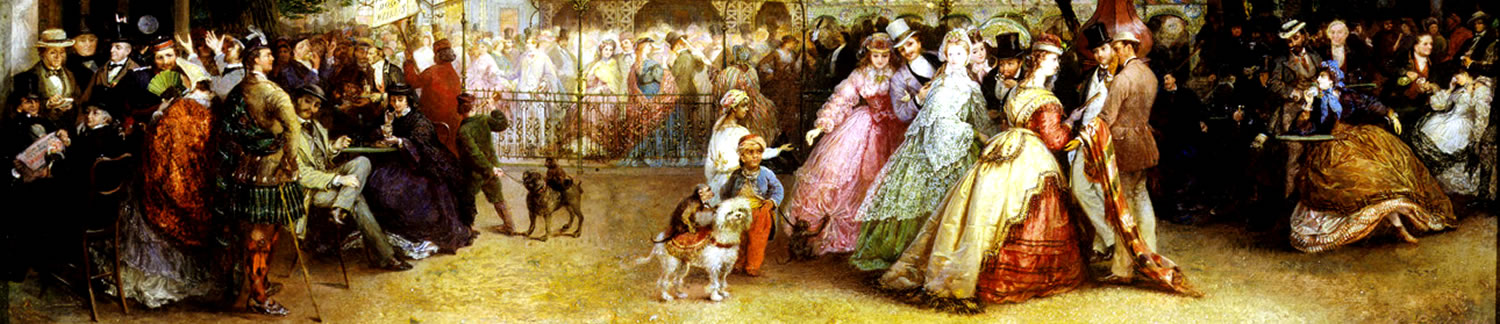
The Great Exhibition at the Crystal Palace in 1851 was an extraordinary phenomenon. Such was its appeal that hordes of folk from all over the country and from all classes flocked to see it. Most were visiting London for the very first time, and many were even venturing outside their own small localities for the very first time; after all, the railway age that enabled this migration was still young. How were the excursioners treated? Did they fall prey to the wiles of urban sophisticates? And how, in turn, did they treat London? Read on to find out, largely as reported in the pages of the northern English provincial press, but also as seen through the humorous eye of Punch cartoonist John Leech in his Memorials of the Great Exhibition series, from which all the cartoons appearing herein are taken.
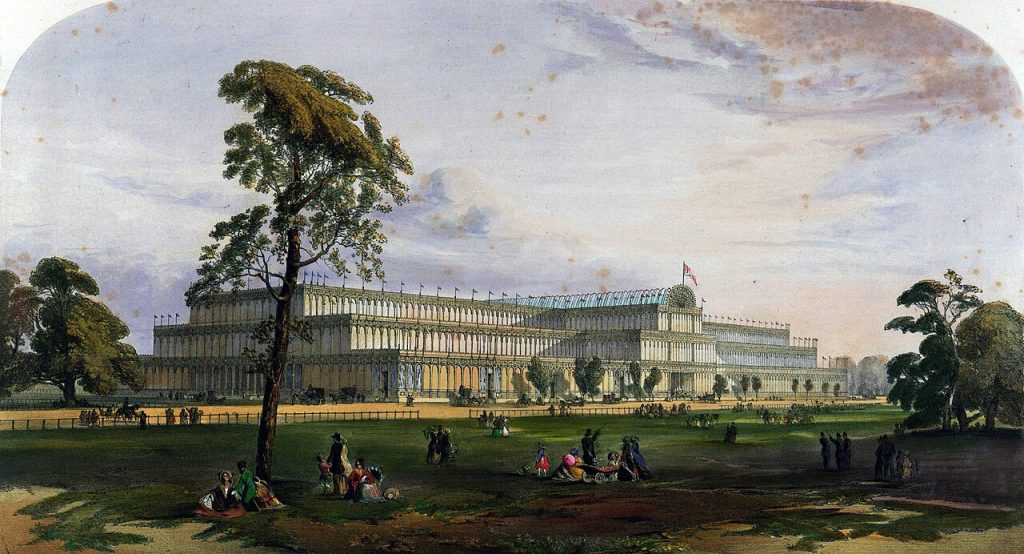
Crystal Palace from the northeast from Dickinson’s Comprehensive Pictures of the Great Exhibition of 1851. Wikimedia Commons.
Over six million people attended this “Great Exhibition of the Works of Industry of all Nations”, held between 1st May and 15th October 1851 in the purpose-built Crystal Palace at Hyde Park, pictured above. Queen Victoria’s consort, Prince Albert, was the prime mover in the enterprise, and it was the first exhibition of its kind to feature industrial and technological innovations from all around the world as well as art works; though a large part of the intention was, of course, to demonstrate Britain’s overwhelming superiority in manufacturing matters.
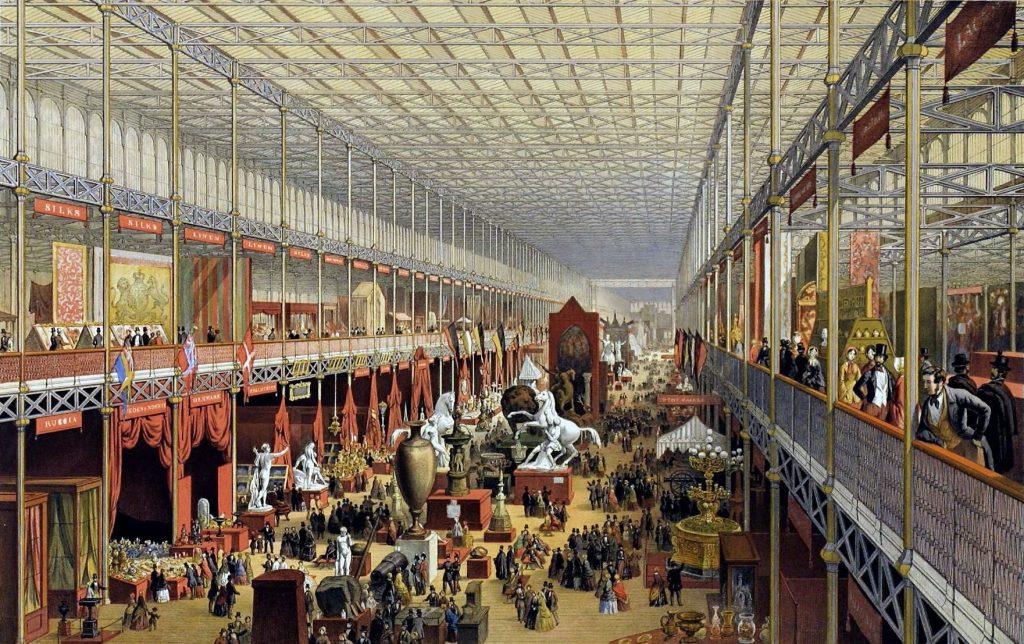
Crystal Palace. Interior. Wikimedia Commons.
The project was self-financing, with entry charges ranging from season tickets priced in guineas to one-shilling only days, to give everyone the opportunity to attend. The very substantial profit that it eventually made was used to fund the founding of the V&A, the Science Museum and the Natural History Museum in the area known as Albertopolis, south of Hyde Park, thereby leaving a significant legacy to the nation.
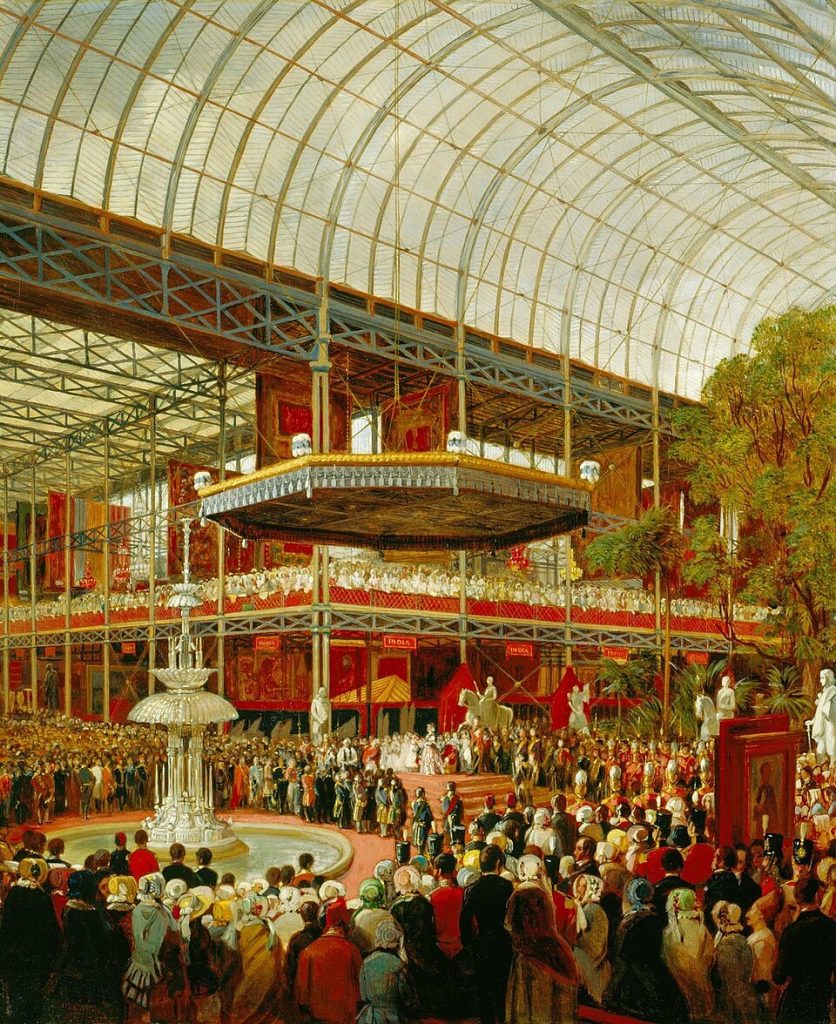
James Digman Wingfield, The Inauguration of the Great Exhibition, 1st May 1851. Wikimedia Commons.
Many doubted that the thing would succeed, or that it should even have been tried, and many feared that enticing the lower orders into central London was asking for riot and disorder. But when the exhibition was opened by Queen Victoria on 1st May, Hyde Park was crowded with a lively, but good-humoured crowd, even though only limited invitees were admitted to the building itself on the day. The weather was fine and the queen, who can be seen at the centre of the above depiction, rode there in procession from Buckingham Palace. The park gates opened at seven a.m., and the Crystal Palace building at nine, though long before these hours huge numbers on foot and in carriages appeared outside the park, and on the route of the procession.
The Standard, published in London that Thursday, observed: “…as early as five o’clock this morning all London was astir to do honour to so great an occasion…From every quarter of the great metropolis thousands upon thousands thronged westward…Every possible and impossible description of vehicle that could jolt along on wheels was pressed into the service…Omnibuses, labelled in fat black letters ‘To the Exhibition’, crowded to the very roof, rolled heavily along… The scene at the gates of Hyde Park itself baffles all description. One dense, unbroken, never-ending line of people swept slowly forward though the gates like a huge river…they seemed like a swarm of gigantic bees…Steady, sober, serious-looking men, who no doubt would, on other occasions, have turned aside from a little gap in their paths, now boldly scaled high railings, dived under horses, jumped over intervening obstacles…Boys ran wildly whooping to and fro…Carriages of every kind came backwards and forwards incessantly, diving recklessly among the people…while hairy foreigners, in every description of outlandish dress, ran distractedly about, entreating everyone to direct them anywhere.”
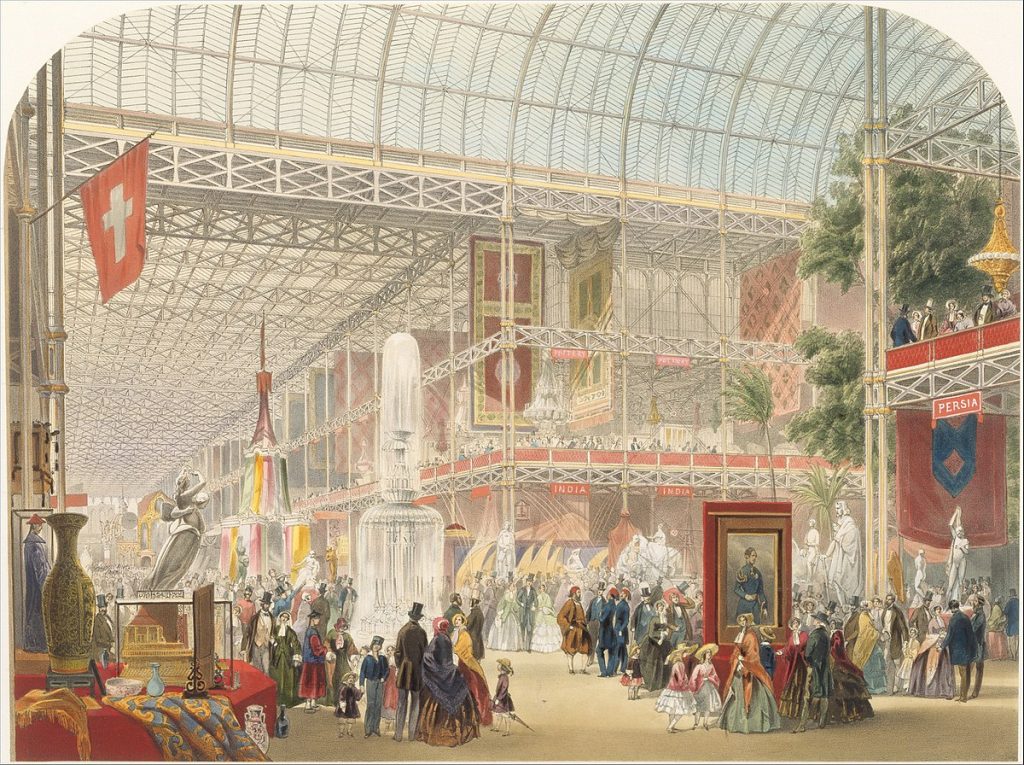
General View of the Interior (from Recollections of the Great Exhibition). Wikimedia Commons. This shows the impressive crystal fountain.
The Liverpool Mercury of 2nd May carried an estimate that no less than 50,000 people had arrived in the capital the previous day: “During the whole of yesterday,” the journal recounted from a widely reproduced article, “unusual bustle and excitement prevailed at the metropolitan termini of the several railways, in consequence of the large influx of visitors, who arrived in hundreds in every train from the early morning mail until the last train at night, in addition to those who travelled in special trains…In the vicinity of the termini there is scarcely a bedroom unlet.” Those conveyed from the coast, the article added, were mainly passengers brought across by the channel ferry steam-boats, and these were swelled by numerous others arriving directly by sea on London’s river.
The Mercury also reported that, “Large musters of the swell mob were in attendance at the various termini, but owing to the excellent precautionary arrangements of the railway and metropolitan police, their exploits were very limited.” “Swell mob” was a slang term for gangs of thieves and pickpockets who dressed well in order to blend in with respectable crowds, while they went about their nefarious business. In the representation of Paddington station, pictured below, the man to the right being arrested by two police detectives is most likely meant as a wrongdoer of this sort.
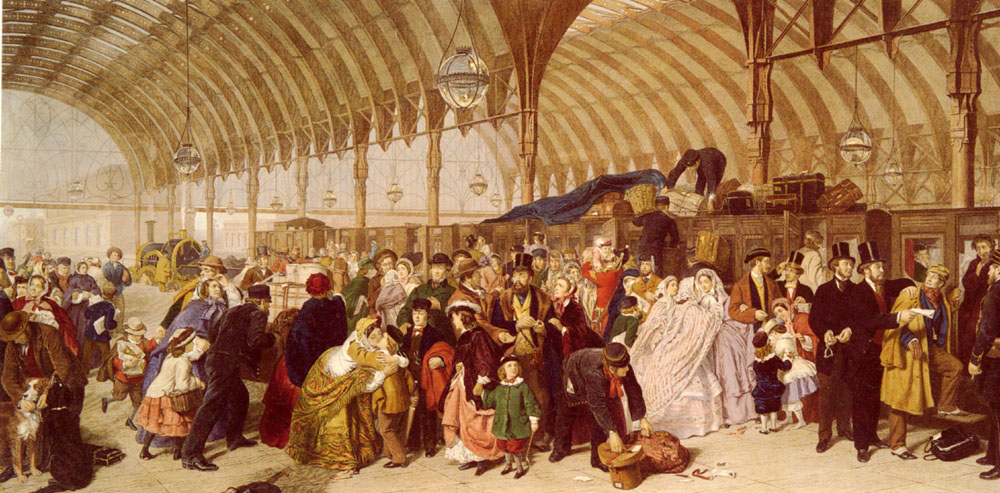
W.P. Frith, The Railway Station (1862). Wikimedia Commons.
Prior to the opening, the London police had been active in clearing the streets of pickpockets. Scotland Yard had also obtained the services of police officers from “most of the large towns of the kingdom” for the exhibition’s duration, including two from Leeds. Two policemen from Newcastle-Upon-Tyne “have gone up to London to render their assistance in preventing the operations of ‘the swell mob’ during the holding of the Great Exhibition.” (The Sheffield and Rotherham Independent 3/5/1851; The Leeds Intelligencer 3/5/1851; The Newcastle Guardian 3/5/1851).
Apartments were engaged for a number of French police officers who were also to be in London for the period, given the number of arrivals expected from there. Indeed, two men acting suspiciously around watches and other trinkets displayed at the exhibition “whose appearance indicated that they were not exactly of the class of three-guinea ticket holders [persons entitled to admission on the day]” were detained by a Birmingham police detective, until he was satisfied of their identity. (Liverpool’s The Albion 21/4/1851; The Liverpool Standard 13/5/1851).
The judicial authorities were also keen to protect innocent visitors from criminality, so that harsh exemplary sentences were threatened to offenders. A respectably dressed man named Samuel Horner, convicted of pickpocketing a watch worth £5 from a bystander in Hyde Park on the opening day of the exhibition, was sentenced by a judge to nine months hard labour. The judge furthermore made it clear that, for anyone with a previous pickpocketing conviction who was convicted of the same offence again during the exhibition, the sentence would be transportation. And anyone convicted of a robbery performed within the exhibition building could expect a sentence of transportation, regardless of whether they had a previous conviction or not. The Northern Star, And National Trades’ Journal, 10/5/1851).
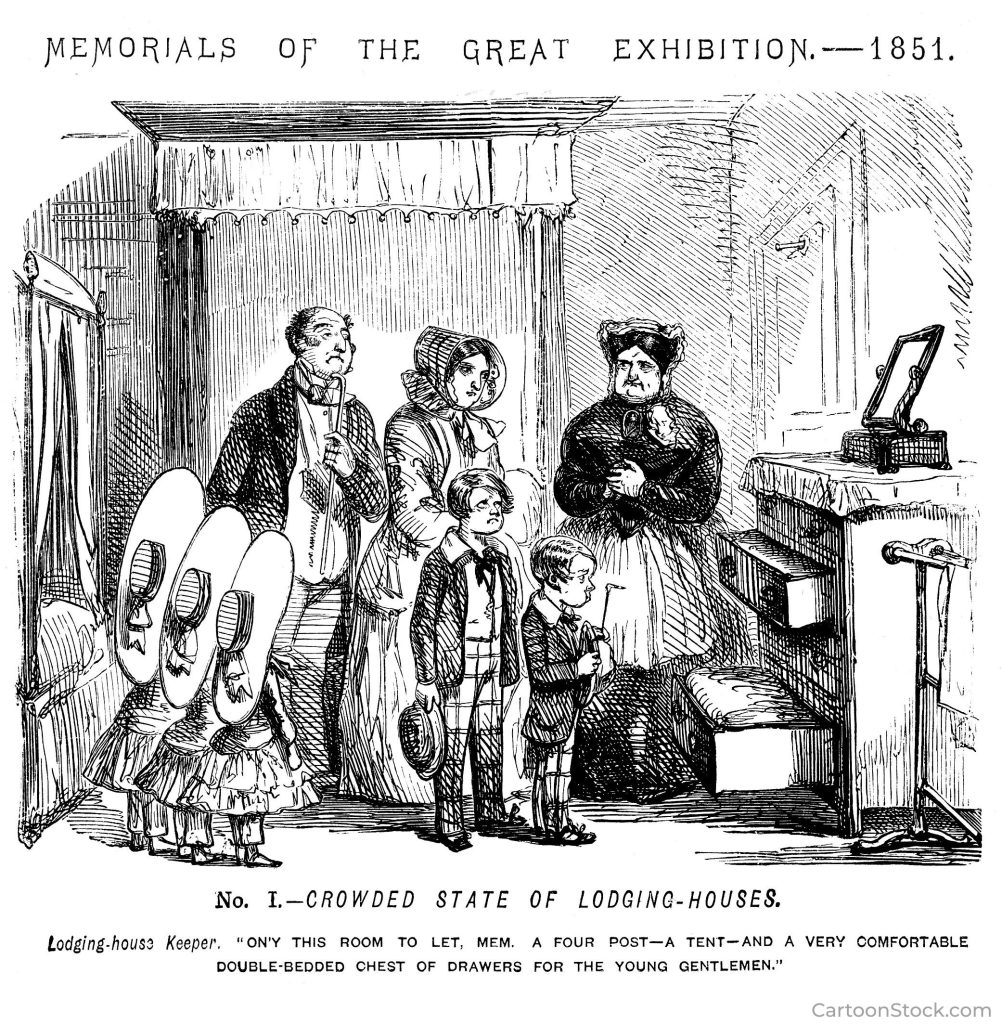
From well before its opening date, a wide range of accommodation was being advertised for persons from the provinces wishing to attend the exhibition. A large furnished house, close to Hyde Park and “within ten minutes’ walk of the Great Exhibition”, could be had for up to twenty guineas a week: “The Pictures and Furniture being valuable, only a first-rate Tenant can be treated with”. Also advertised as being within ten minutes’ walk of the exhibition was the Queen’s Hotel, Bayswater, a “Superior West-End Boarding Establishment”, with full board for a “Gentleman and Lady” costing up to five pounds and five shillings a week. (Liverpool’s The Albion 7/4/1851).
More modest berths were available at “The Exhibition Boarding House”, Holborn Hill, where bed and breakfast at properties especially furnished for the exhibition period, could be had for five shillings a night. At Clarence Club House, near Chelsea Hospital, rooms “for artisans and others”, were two shillings and sixpence a night. The “Working-man’s Home”, Vauxhall Bridge, declared itself particularly adapted to provide for “mechanics from the manufacturing districts” during the exhibition, at one shilling per night. (The Liverpool Mail 3/5/1851; The Liverpool Mercury 2/5/1851, 6/5/1851).
On 7th June, a correspondent to the Leeds Mercury warned all London-goers to be well-prepared, preferably to seek safety in club or excursion groups, and not to step straight off their train into the first establishment that presented itself: “Some of the boarding and lodging houses in the neighbourhood of Euston-square and King’s Cross are at present occupied with some of the sharpest and cleverest thieves in London…The unsuspecting and unwary are drawn into company the moment they arrive, and before the evening has passed their golden dreams of the exhibition…are vanished…and their hard-earned savings transferred to other and more unworthy hands.”
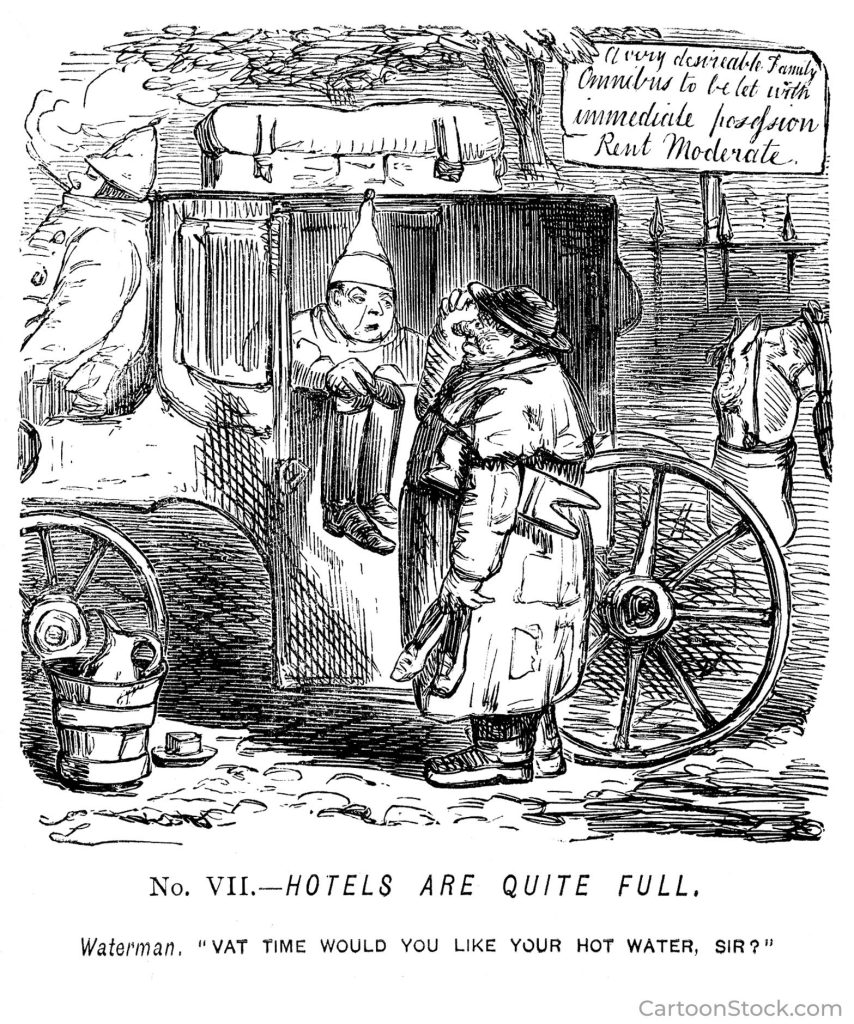
From the month before the opening, the London and North-Western Railway was offering special return excursions to begin in May from Liverpool’s Edge Hill station, with a choice of four, six, seven or nine days in town. By June, it could be reported that: “Probably since the introduction of railways, a greater influx of visitors in the metropolis was never witnessed than was evidenced this Whitsuntide…the Euston-square terminus of the London and North-Western Railway presented a very bustling appearance, for beside the ordinary trains, which were much crowded, there were as many as twenty excursionist trains from the…main and branch lines from Oxford, Northampton, Rugby, Birmingham, Wolverhampton, Manchester and Liverpool. (The Liverpool Mercury 4/4/1851; Sheffield and Rotherham Independent 14/6/1851).
The Midland Railway and the Great Northern Railway offered regular, increasingly cheap, trains to London from many Yorkshire towns, including Leeds, Bradford, Wakefield and Sheffield. In fact, by July the two companies were locked in a rivalry, “which exhibited itself…in a downward race as to which should take passengers for the lowest fare!” This apparently caused “considerable excitement”. One Tuesday afternoon the Midland announced return fares so low, at twenty shillings first class, ten shillings second, and five shillings third, that by the evening Bradford station “was besieged by a crowd of travellers, bustling under the burden of top coats and cloaks, carpet bags, portmanteaus, baskets, & c…and large crowds of persons, enticed by the sounds of music perambulating the streets ere the departure of each train assembled to see [each] depart to London.” (The Leeds Times 12/7/1851).
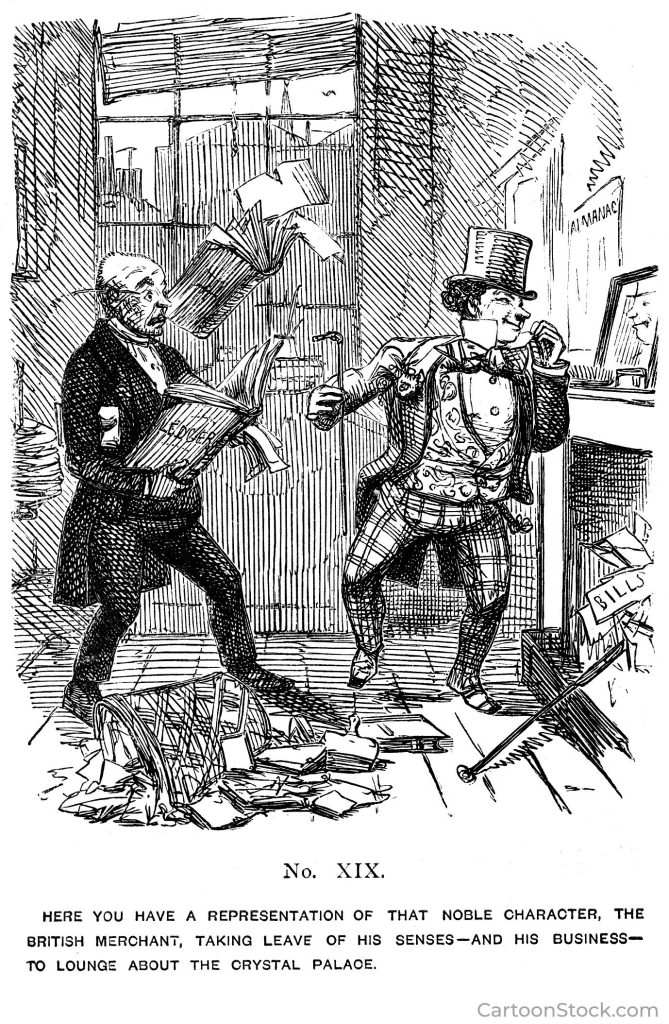
It was reported in June that nearly all of Bradford’s wool merchants had gone to the exhibition. In April, Liverpool merchants Brown, Shipley & Co presented ten of their clerks with £100 (between all) to enable them to go there, and a few days later it was reported that all the American commercial houses in the town would be following this “liberal example”. The Liverpool Insurance Company presented its clerks, and even its office boy, with £10 each to attend the exhibition. The Railway Foundry in Leeds closed for a week in July to allow its substantial workforce to visit the Crystal Palace, while the Iron and Citizen Steam-boat Company gave all their servants (between 400 and 500) £40 and a holiday for the same purpose. (Gore’s General Advertiser 5/6/1851; The Liverpool Mail 19/4/1851; The Liverpool Standard 22/4/1851, 10/6/1851; The Leeds Intelligencer 7/6/1851).
Such liberality was common throughout the north, which had provided many of the industrial exhibits. “Among the many illustrations of the auspicious influence of the Great Exhibition in promoting relations of kindness and good will between different classes,” asserted The Leeds Intelligencer on 12th July, “we know of none more interesting than that…of Robert Milligan, Esq., of the firm of Walter Milligan and son, of Harden Mills, Bingley. On Friday…this gentleman proceeded to London with forty of his workpeople, including nine females, secured comfortable lodgings for them at the Bell Sauvage, Ludgate Hill, [a coaching inn refurbished for the exhibition] and took up his abode there himself, in order to devote his services to them as friend, companion and guide.” They stayed for a week, during which Milligan defrayed all their expenses, and “the happy party returned to their home delighted and instructed by what they had seen.”
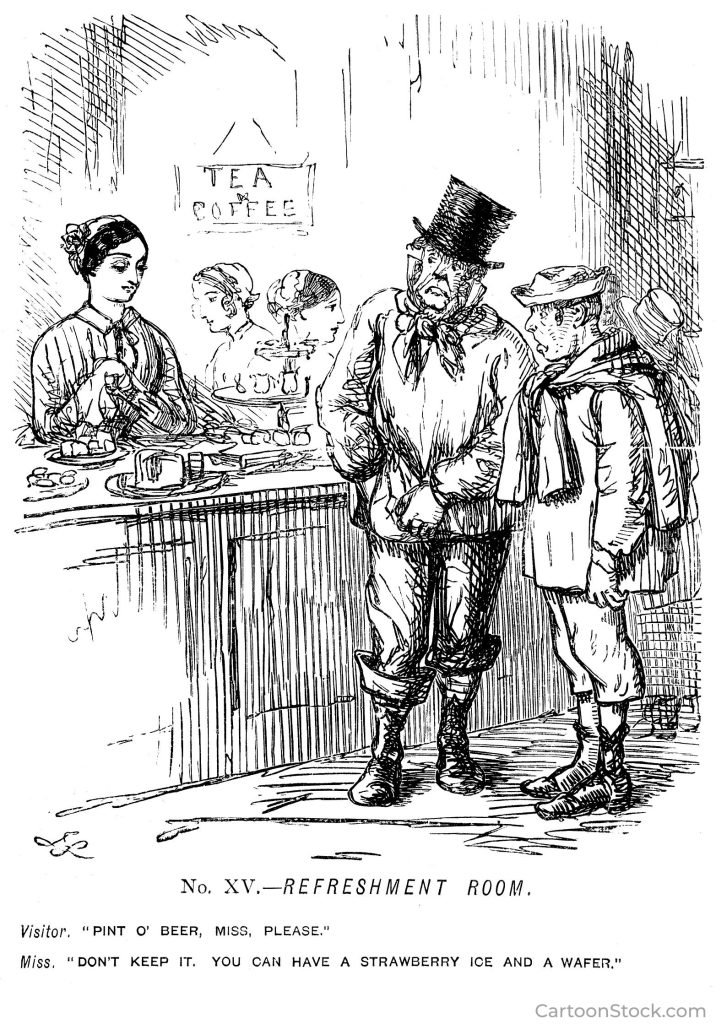
Visitors expecting the provision of alcoholic drink would be disappointed. “Large as the building is,” The Liverpool Mail reported on 19th July, “there is only one gallon of ale in the entire, and this is contained in a glass keg, hermetically sealed, in the south-western gallery.”
In its 7th June edition, The Leeds Mercury reported with some pride on the industrial components of the exhibition: “There is no part of the building that appears overloaded with objects…The attractions are so diffused that the company naturally disperse in quest of them. The machinery runs well, – spindles revolving with sightless speed, shuttles clacking, cylinders carding cotton, flax and wool, – stocking frames, lace frames, silk-throwing frames, wool combing machines, card-making machines, needle making machines, great printing machines of the newest invention, pumps, all sorts of steam-engines, and many other machines and models at work.”
And there were manufactured goods of more commonplace description. “The remotest parts of the building find interested spectators, and every day’s experience is…developing the connection between occupations of life and the kind of commodities with which they are conversant. On Monday…a cook…was with great animation pointing out…the merits of an immense kitchen-range, with culinary apparatus complete, in the hardware department.” There was a section of agricultural implements where, “Down these long rows of formidable machines farmers may now be seen at all hours of the day bending their sturdy steps, pausing occasionally to examine as they go. (The Liverpool Mercury 30/5/1851).
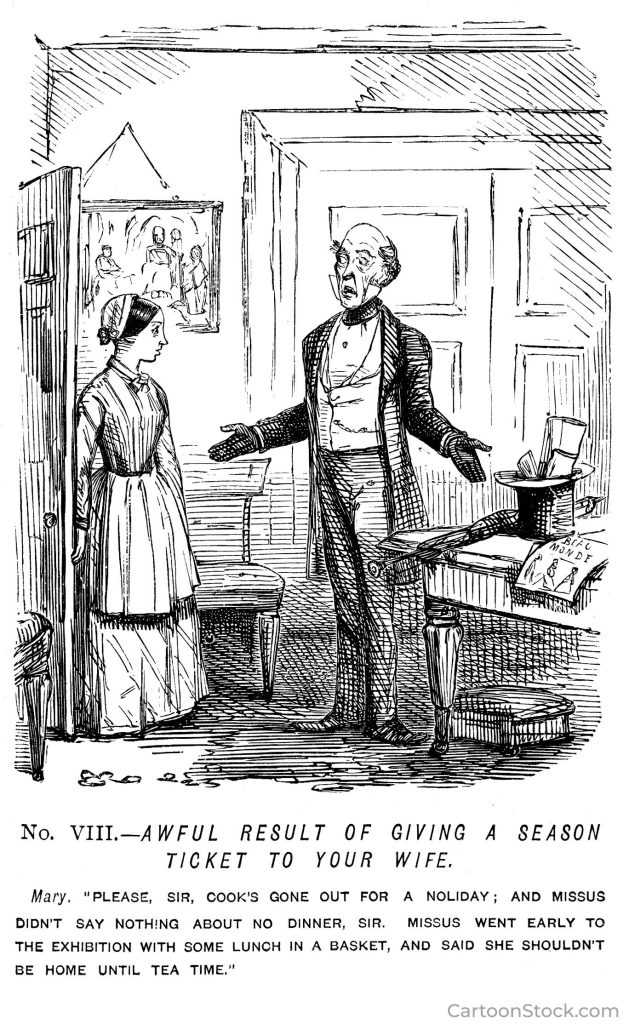
The exhibition proved a magnetic draw for some, to the disadvantage of others.
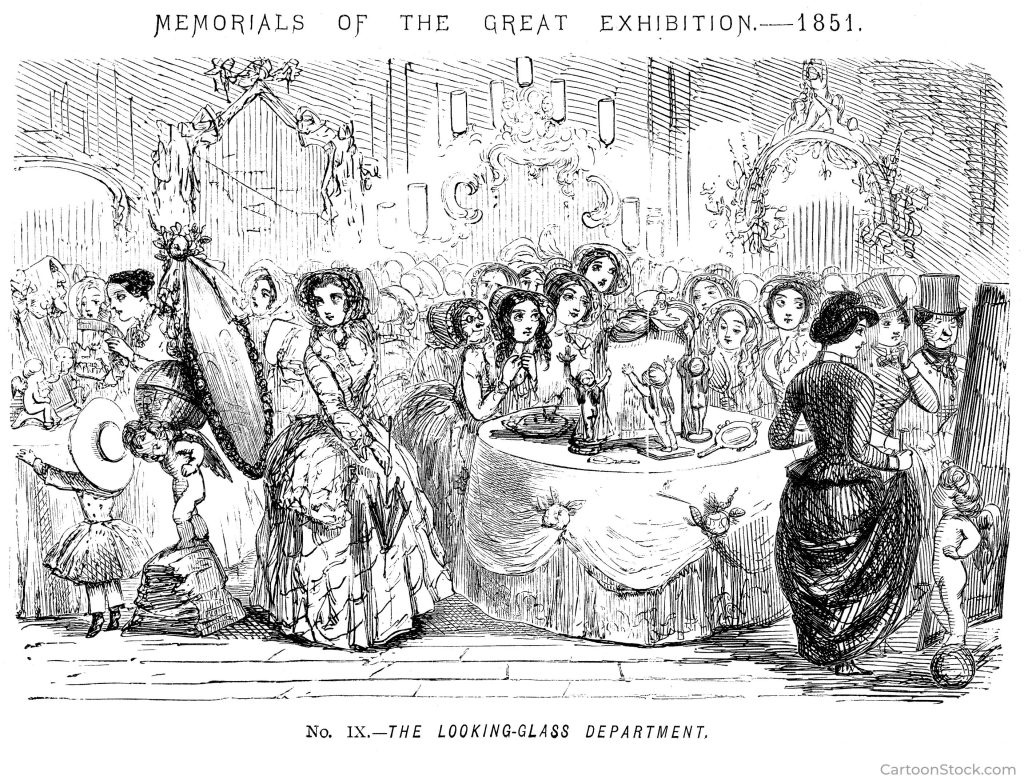
There were also gentler attractions than machinery, such as displays of clocks, jewellery, furniture and fashions. An illustrated catalogue of the substantial art works on show was published. Liverpool’s The Albion reproduced on 2nd June an article from French journal Le Follet including the following: “Formerly a visit to London was of no more importance to the ‘Parisienne’ than a visit to any other fashionable resort…The Great Exhibition has, however, given an impulse both to the taste and rivalry of the skilful ‘modiste’. It is no longer simply as ‘touristes’ to London, but as visitors to the ‘Fairy Palace,’ that our fair countrywomen are forming themselves into large companies for this interesting pilgrimage, and in the elegance and beauty of their toilettes a pardonable spirit of national pride is discernible.”
Provincial Englishwomen could aspire to the same. James Maclennon of Bold Street advised the “Ladies of Liverpool”, in The Liverpool Standard of 20th May, that he “has now ready all the NEW STYLES in MANTLES, direct from Paris, and various novel and splendid pattens in SHAWLS, identical with the beautiful specimens deposited in the Great Exhibition.”
The rural peasantry was not excluded from the jamboree. “A very interesting episode in the day’s proceedings,” related The Liverpool Mercury on 17th June, “was the arrival of the whole adult population of three parishes in Sussex, headed by their clergyman, who had come up by excursion train early in the morning from Godstone.” There were apparently 800 of them. “The men were all dressed in new smock flocks, and the women [were] most tidily and neatly attired, and did infinite credit to their district.” The Northern Star, published in Leeds on 13th September, told of how the Duke of Norfolk had given a holiday to 60 of his West Sussex farm labourers. After giving them “a substantial breakfast at Arundel” he had them taken by express train to London Bridge station. “They made their appearance in the Exhibition in full agricultural costume, with green rosettes in their hats, surrounded by ears of corn, as the signs of a completed harvest.” Both country parties returned home the same day.
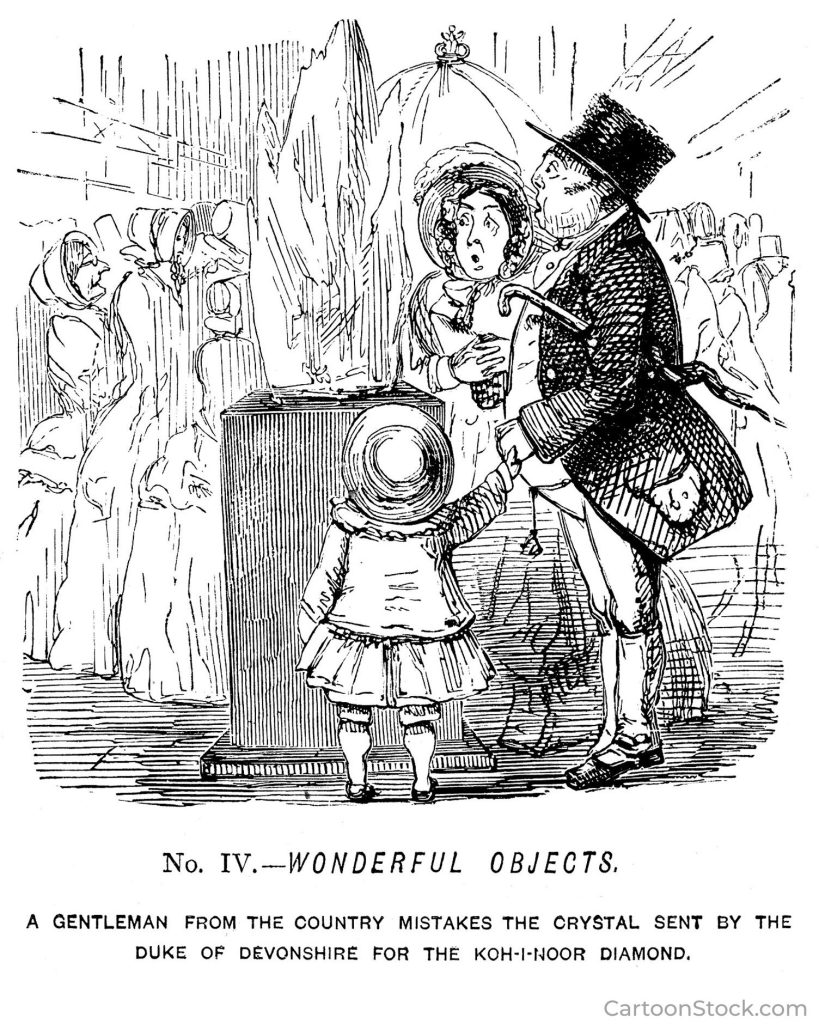
Though big for a diamond, the Koh-I-Noor exhibited was not that big.
Other groups making the journey included a temperance party from Glasgow, arriving at London Bridge on the screw-steamer European, specially chartered for the purpose and forming their lodgings during their stay. Many towns formed dedicated excursion groups, on the payment of subscriptions, including a “London Excursion Club” in Liverpool which offered a railway day return, and a guide book, to working class depositors. Others had more tortuous journeys. “A Persevering Fellow” from Gainsborough walked all the way to London and back with only a basket of provisions, saw the exhibition, slept for three nights in a tree in Hyde Park, earned a few shillings by “riddling sand”, and was home in twelve days.(Sheffield Independent 3/5/1851; The Liverpool Mercury 8/7/1851; The Blackburn Standard 16/7/1851).
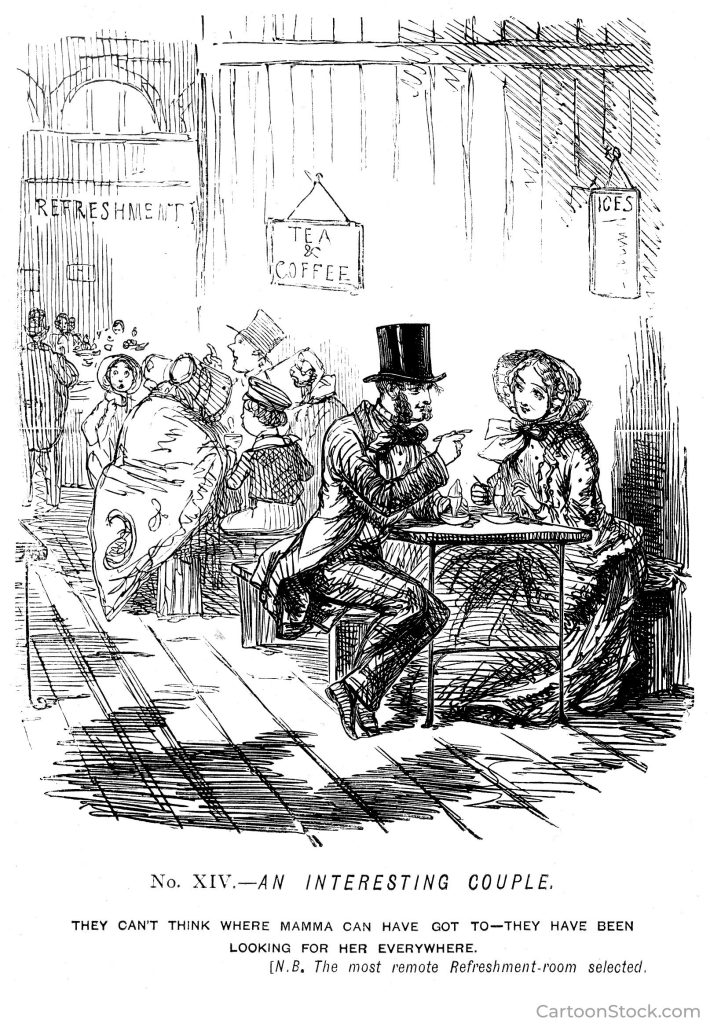
Fifty “Radical” (presumably politically) girls from Bath and the same number from Bristol were sent up to the Crystal Palace by Sir John Hare of the Royal Crescent in Bath. Some of them got lost in the crowds, and, after being found, were looked after at the police station labelled appropriately “Bath” or “Bristol”. Naturally plenty of children were mislaid in the exhibition’s large expanse, including “a hulking country lad of twelve or fourteen” who had lost his mother, “blubbering at a rate which put Eugene’s inimitable statue of ‘The Unhappy child’ quite to shame.” Some young people, however, were more than happy to lose Mamma, as the following cartoon suggests. (The Liverpool Standard 8/7/1851, 10/6/1851).
“A great number of artizans have left Bolton for the Great Exhibition during the past week”, reported The Blackburn Standard on 18th June. These apparently included an elderly couple name Bentley, who planned to also visit their son while in London. Their preparations became known to the workpeople at the Soho Works, where the son had served an apprenticeship. Wishing to express respect for the old couple on their day of departure “they assembled in front of Bentley’s residence, with an armed body guard, to escort the aged couple to the railway station.” A centenarian lady named Power, claimed the Bristol Times on 4th October, had just returned from visiting the Great Exhibition, and, “The old lady appeared to be in excellent health and spirits.”
London was also awash with foreigners come see the exhibition, many in national costume. The Liverpool Standard carried this from a correspondent on 8th July: “In passing from Hyde Park Corner to Temple Bar, the other day, I saw two Chinese youths on top of an omnibus; three Negro princes, well dressed, and swaggering along the Strand in the happiest style imaginable; an Armenian in full costume; a party of Turks; [and] two Parsees from our East Indian possessions; not to speak of a countless number of Germans, Frenchmen, and Americans who, though not so remarkable in their costume, are easily discovered by their features.”
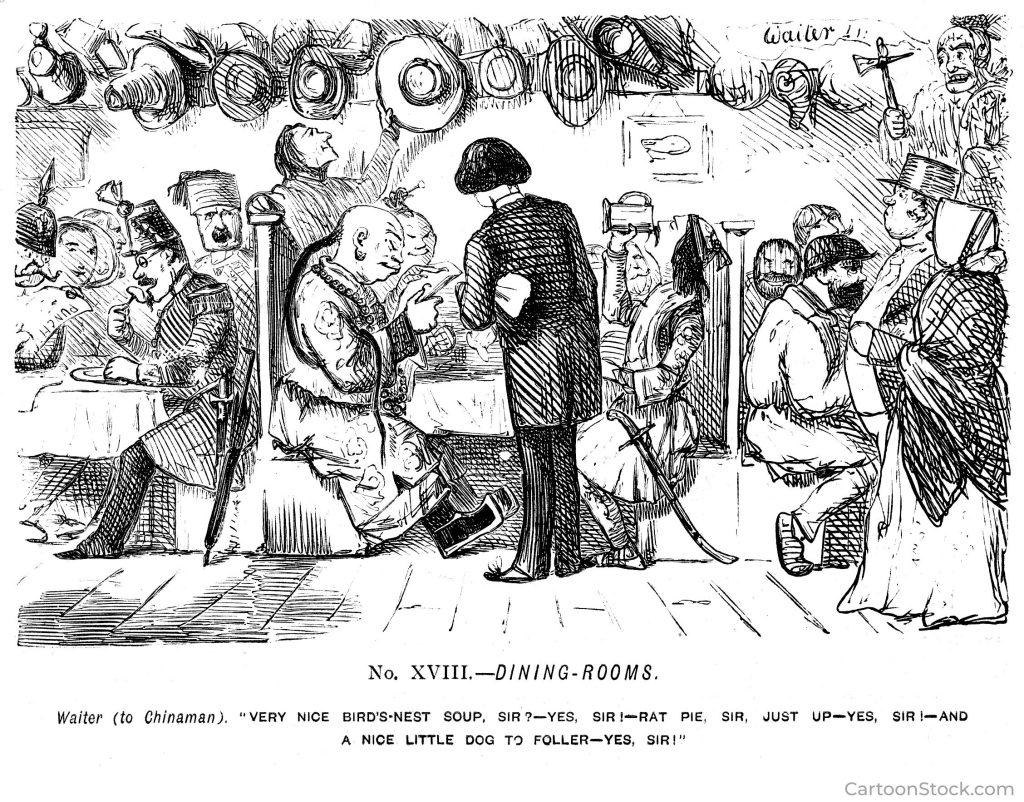
Political correctness had not yet been invented.
One might suppose that London traders would do very well out of this massive and varied inflow of potential customers. However, from the early days of the exhibition, it was claimed that the opposite was true. The following is taken from The Liverpool Mercury’s summary of 23rd May:
“If the Great Exhibition is in all respects answering the most sanguine expectations which were formed of it by its founders and promoters, it is apparently not answering the expectations which were formed of it by the metropolitan traders and speculators. It is said that all classes of purveyors for the public are grievously disappointed…These effects are attributed to the economical, if not the stingy, habits of the visitors whether foreign or domestic…and to the fact that the inroad of the unfashionable multitude has deterred the aristocracy and gentry from making the metropolis the place of residence for themselves and their families during the summer season.”
Members of the social elite came annually to London for its social “season”, which ran broadly through spring and summer, until they returned to the country in August for the start of the shooting season. Quoting from London’s Morning Herald, The Liverpool Mail added on 24th May: “This noble lord comes up without his family or retinue of servants – that right hon. baronet visits the metropolis at intervals, and stays at an hotel with his single valet, so that the benefit derived in ordinary years from the household and servants… and from the dinners, balls, and reunions which then take place, has not this year been realised.”
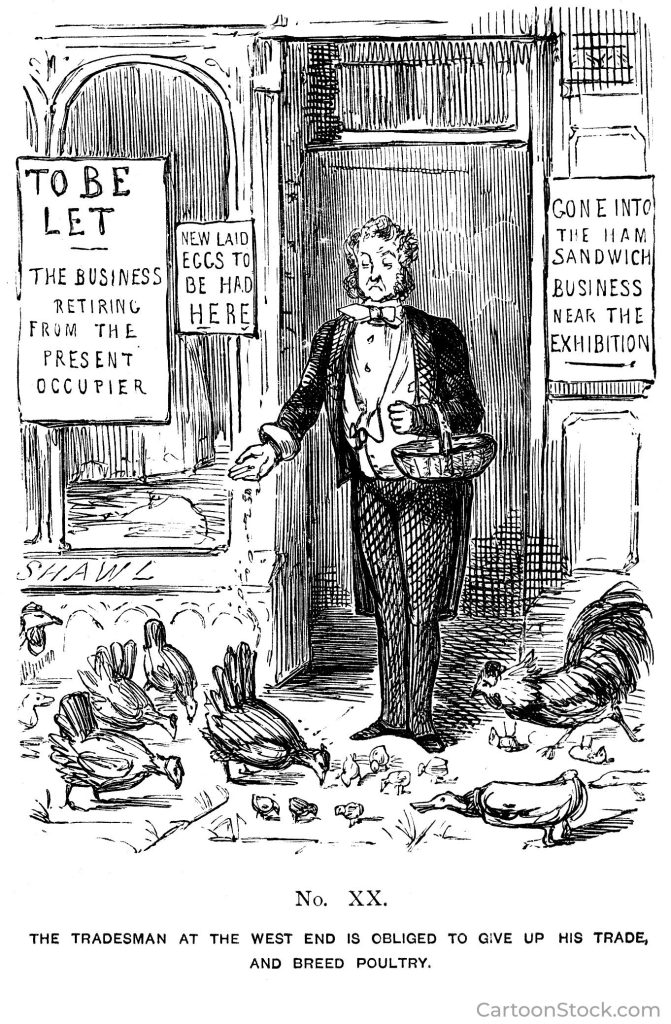
The Mail went on to argue that smart West End shopkeepers, and speculators in letting high-class West End lodgings, had therefore done worse than usual. Quoting again from the Herald it stated, “The fact that thousands…have come up from the provinces we readily admit; but a majority of them are persons of small income, and of careful, not to say penurious habits.” One labouring man from Huddersfield was reported by The Leeds Intelligencer on 26th July as having gone down to London on a Tuesday night “with only a sandwich in his pocket and a shilling in his purse, after paying his fare of 5s for a third-class railway return ticket.” Having paid his shilling entry to the exhibition, he returned over the Wednesday night, “without having spent a farthing for either lodgings, eating or drinking” during the hours he was away from home.
His was perhaps an extreme example, but it is reflected in an account of visitors’ behaviour on a one-shilling entry day, published in The Liverpool Mercury on 13th June. “There were a great many people evidently from the agricultural districts and the provincial towns, who arrived in parties, and whose astonishment on first entering the building it was exceedingly interesting to watch…Shortly after twelve o’clock, the country folk, who had brought baskets with them, well stored with provisions, proceeded to recruit their exhausted strength therefrom, and homely unpretending luncheons were dispatched with great gusto, and washed down afterwards by copious draughts of water from the nearest fountain.”
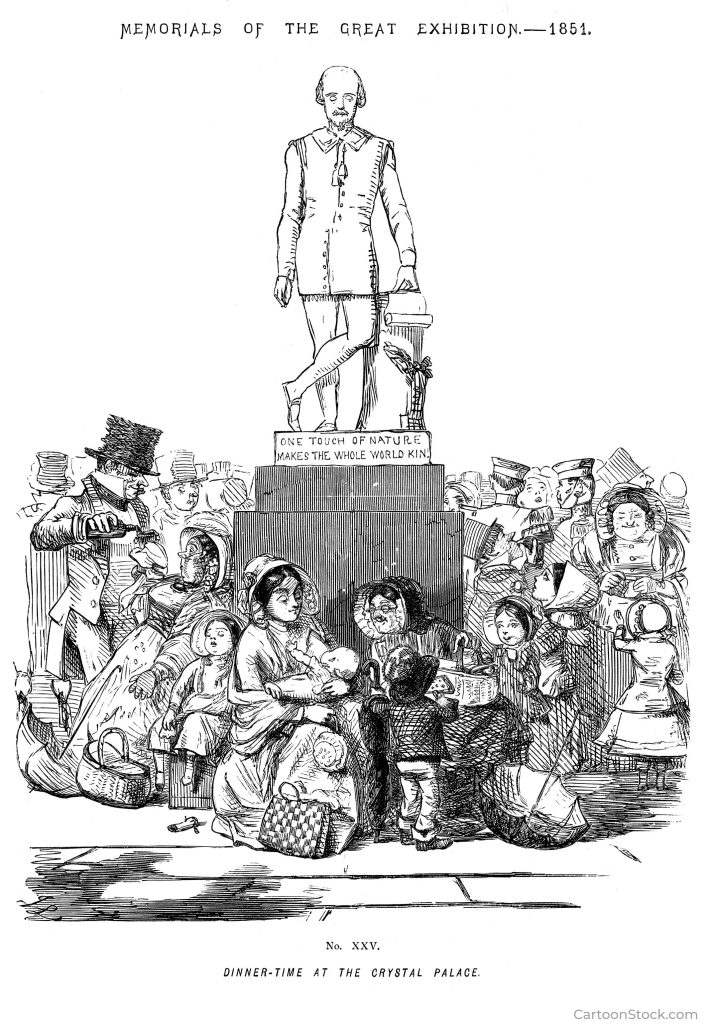
Although the refreshment rooms did a lively trade, many preferred to buy cheaper provisions (and the beer that was not on sale on-site) elsewhere, or to bring their own, and to go straight back home in the evening to avoid lodging costs. And such people did not necessarily spend spare cash by making visits to other places of amusement. In a highly critical article on 2nd June, London’s John Bull complained that, “The companies at the theatres have had to perform before empty boxes…The tradesmen of the metropolis whose contributions were extracted with little regard to delicacy towards the erection of the great glass-house find to their mortification that they have been made to subscribe to a scheme which is robbing them of their custom for an entire season.”
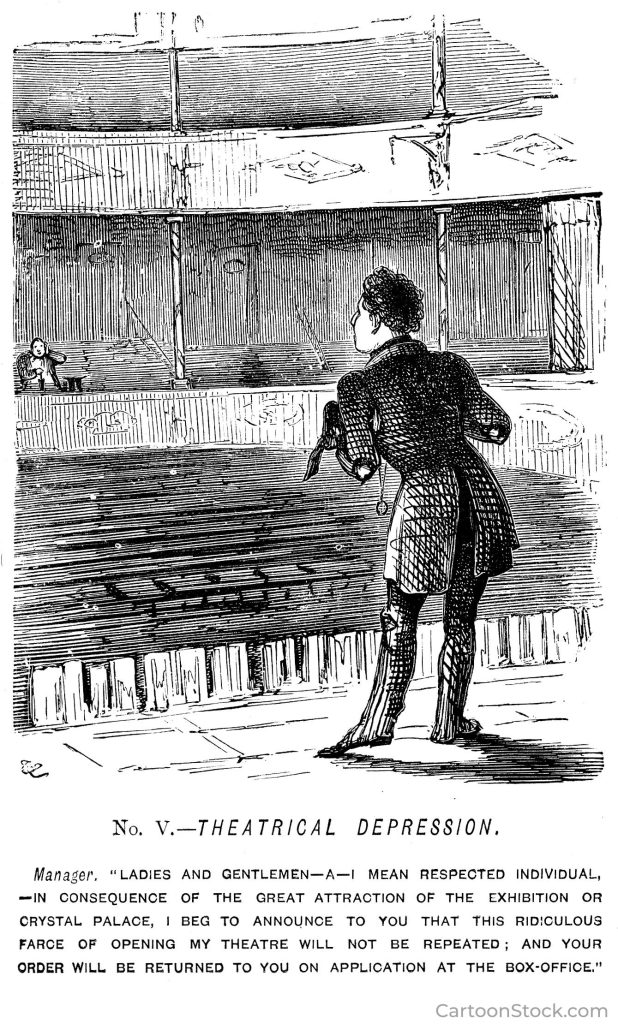
Opinions differed on how far different sectors of London’s, and indeed the nation’s, economy actually benefitted, or suffered, over the Exhibition period. London’s lodging house keepers and omnibus and cab men were obvious beneficiaries, and it was argued that some other tradespeople protested too much! In a balanced assessment on 23rd September, The Liverpool Mercury considered that: “The people of London have not yet decided the knotty question, whether the exhibition has been prejudicial or not to the trade of the metropolis. Both the negative and the affirmative find a multitude of stout supporters.” It does seem clear, however, that a great number of ordinary people had a novel, and enjoyable, experience on their own terms, without being exploited. And, as the Mercury added, “it has had an absorbing influence on the people, and has tended…to give the country a most tranquil political aspect.” This was a notable statement, since the last mass working-class Chartist demonstration, on Kennington Common, which had put London in fear of revolution, had taken place only three years previously in 1848.
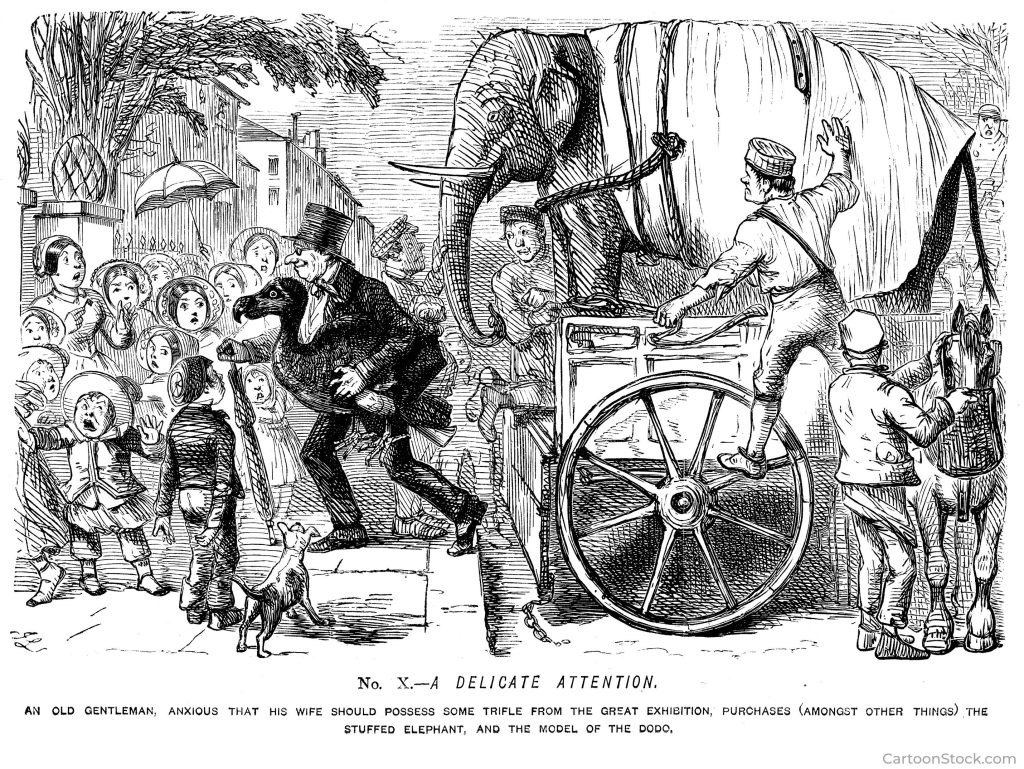
Some exhibited items were put on sale.
As the exhibition neared closure on 11th October, The Leeds Times commented thus about its visitors: “Amid these countless throngs good conduct and decorum reigned supreme – ‘the people,’ who were to sack London, ravage May Fair, lay waste Belgravia, carry off the Queen, and crucify Prince Albert, actually behaved better when congregated in these masses, than the aristocracy, (who affect to fear them) are sometimes found to deport themselves on an opera night.” And the graded entry price system, as The Liverpool Mercury remarked on 30th May, had enabled “a fraternisation of the great and the humble” on many days of the exhibition.
The Leeds Times article also contained the following eulogy on the impending closure: “Only a few days will now elapse and workmen will rush in to dismantle that fairy edifice, compared with the wonders of which all temples of enchantment dwindle into utter insignificance. Clumsy packing-cases and dirty straw will usurp the place of the jewelled tiara, the silver tissue, the golden fretwork, the sculptured marble, the life-like painting…and all the richest and rarest that the head of man could devise, or the skill of man execute. And henceforth we must trust to our books and our memories for a record of an event such as the world never before conceived, and will probably never again realise.”
On 25th October, the Bristol Times bemoaned the end with the following questionable advertisement: “AFTERNOON EMPLOYMENT WANTED by a Gentleman who, in consequence of the closing of the Great Exhibition, doesn’t know what to do with himself. Address, A. LOUNGER, Esq., Fop’s Alley.”
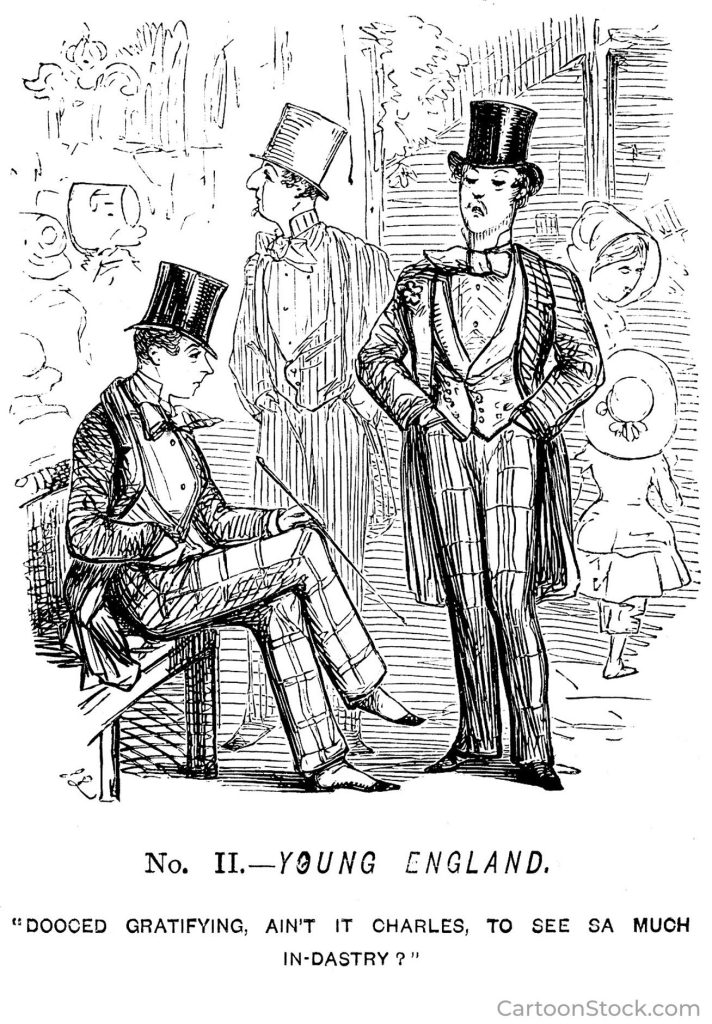
The cartoon depicts a type of foppish character of affected dress and speech, common to the period.
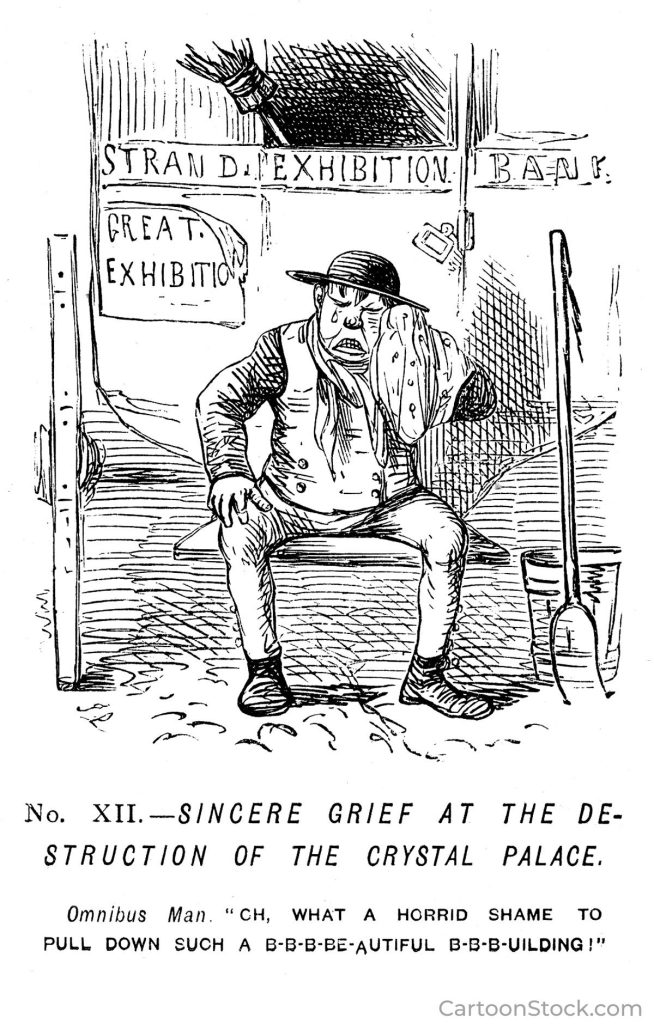
The Crystal Palace was dismantled and rebuilt in South London, where it remained until its destruction by fire in 1936. It is the loss of custom, of course, rather than the building, that upsets the omnibus man.
Finally, a brief word on John Leech (1817-1864): A cartoonist with Punch magazine for many years, Leech was an acute satirical observer of early Victorian society whose work provides a tremendous window onto the times. Though his scenes are obviously fanciful, he is regarded as having been scrupulously accurate in depicting matters of fashion, appearance and manner. He was himself a dapper dresser, without being showy, knew hardship from the time of his upbringing, and had a social conscience without being a moral campaigner. He collaborated with Charles Dickens, and was the original illustrator of “A Christmas Carol”. Further reading: “John Leech and the Victorian Scene” by Simon Houfe, 1984.
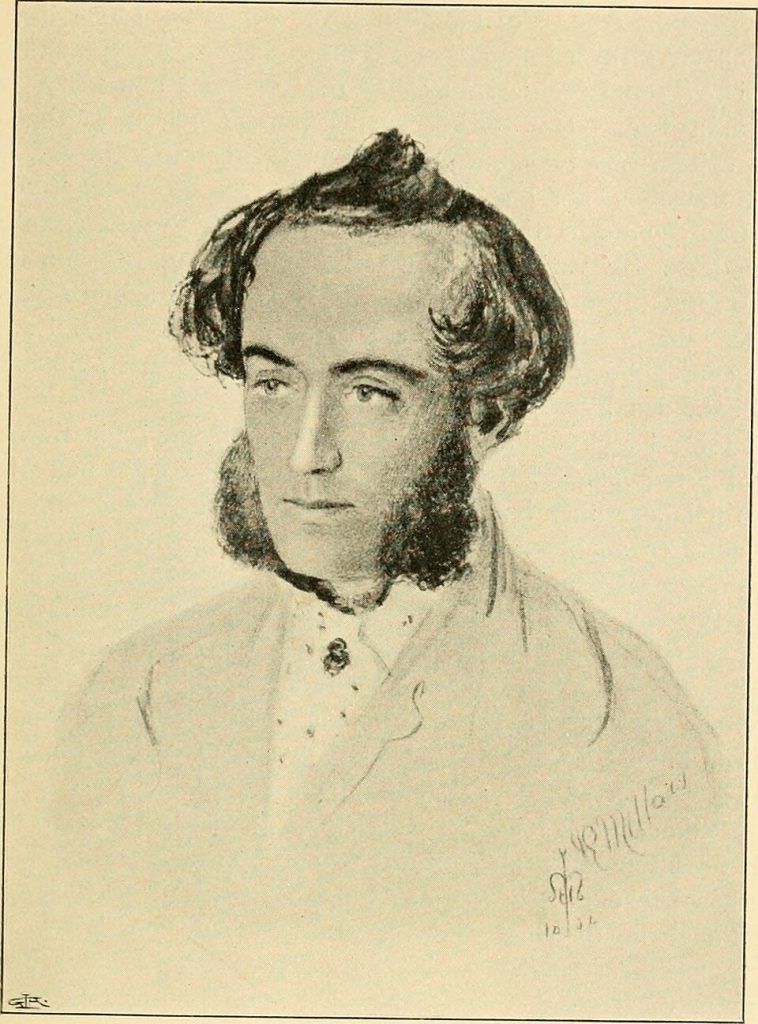
John Leech. Portrayed by his friend the pre-raphaelite painter John Everett Millas at around the time of the exhibition in 1852.
A tour-de-force. A very well structured account, combining contemporaneous newspaper extracts with the usual pithy historical commentary adding context. The great selection of Punch cartoons enlivens the experience. Your best blog yet. I applaud you.